Results
For the following data, two backyards had pictures taken of them and the species of vegetation within each picture was identified and counted to the best of our ability. The species diversity and evenness were then analyzed using this gathered information, evenness being how proportional the number of individuals of each species are in relation to the other species. The closer to 1 that the species evenness get to, the more even in population level each species is to each other. For the first backyard (Fig.1), the species diversity was calculated using the Shannon-Wiener Index (H’), resulting in a value of 1.53. The higher this value, the more diverse the environment. The species evenness (E=0.951) was then calculated using H’ and species richness (R=5).
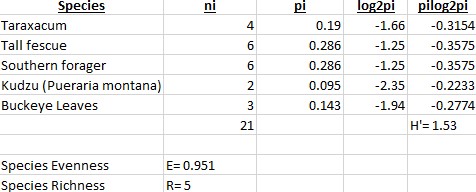
In the second backyard (Fig.2), the species diversity was calculated to be 1.08. The species evenness was 0.983 and species richness 3.
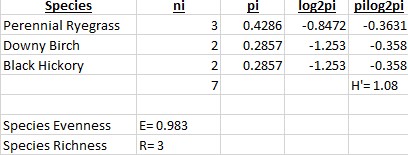
When comparing the two backyards to one another, we see that the H’ for backyard 1 is greater than backyard 2, which implies that the environment for backyard 1 is more diverse. However, the species evenness is greater in backyard 2 due to being closer to 1. In backyard one, Tall Fescue and Southern Forager dominated most of the are, and this is most likely due to the two plants having an advantage in that particular environment, whether that’s moisture level or sun exposure. In backyard 2, there was no real dominance of one species over another, which is most likely due to a lack of competition from other species.
Characteristics of an ecosystem with a high Shannon-Wiener Index include places with a healthy balance of rain, warmth, sunlight, and soil nutrients. Duration and intensity of the warm seasons also effects the outcome of this measurement because some plants take months to bloom. The presence of invasive species can negatively effect the diversity due to the higher success in competition between the invading and native species, resulting in the reduced fitness of the native species. The higher diversity level of backyard 1 is due to a lack of maintenance and high moisture level in the area is resides in. Water collects heavily throughout that area and the vegetation is rarely disturbed or cut. Along with this, the spot gets plenty of sunlight even though it’s at the base of a tree. In backyard 2, the lower diversity level is most likely due to selective, regular maintenance of the area along with the dominance of trees shading most of the sunlight.

