A blog post by Derik Verkest and Bo Nash
Introduction
Adaptations and variation of individuals in species is an important part in their evolutionary growth. These adaptations help them function at their optimal level throughout their life. In this experiment we analyzed the adaptation of a single species of oak leaves. You may be asking: How can their be differences within a single species? The answer to this is a concept called within-individual variation. Even if two individuals have the same phenotype (physical characteristics) and are in the same environment chance processes unique to the individual will create differences in survivability and reproduction. This essentially means that adaptations occur in the same species because individuals might be living in a different niche than their counterparts. Although we will not be analyzing this concept as much as within-individual variation, between-individual variations provides key insights that could help the experiment be analyzed better. This variation is when individuals with different phenotypes will experience differences in survivability and reproduction. This is considered the variation within populations instead of within individuals.

http://arborscapesllc.com/wp-content/uploads/2016/06/oak-leaves-bedfordshire_edited-1.jpg
Experimental Background
In this experiment we accessed within individual variation of oak leaves. Variation in leaves are important because of two main functions of leaves themselves: (1) the leaf must capture sunlight for photosynthesis, and (2) the leaf must take in CO2 through pores called stomata without losing too much water. The reason that there is variation within oak leaves on the same tree is that the leaves are different based on where they are located on the tree. If they are on the multi-layer canopy they might adapt for gathering more sunglight without drying out. If they are on the mono-layer inside then they would try to gain as much sunlight as possible. We predicted that the leaves from the outside would have a smaller surface area than leaves on the inside so they could optimize light intake without overheating and drying out. We believe this is the case because the smaller leaves could still undergo optimal photosynthesis because they receive more direct sunlight due to them being on the canopy. But at the same time they would have a smaller surface area so they wouldn’t overheat or dry out through CO2 intake.
Experiment and Results
Leaves of an oak tree vary in size, being broader to optimize sun exposure and being more narrow to minimize heat stress. The objective of this experiment was to test the hypothesis that if the sunlight exposure of leaves vary among the leaves of an oak tree, then the leaves that are on the outer part of the tree would be more narrow than the leaves on the inner part of the tree. To test this hypothesis, data was collected on the sizes of four groups of ten inner leaves and ten outer leaves. Each group had a pile of ten outer leaves of an oak tree and ten inner leaves, and measured the area of each leaf in squared centimeters. In order to do this, each leaf was placed on square-centimeter-grid paper and traced. Once traced, any squares that were more than 50% covered by leaf were counted towards the total area of that leaf.
After all four groups of leaves were measured, the data was collected to analyze the within-individual variation and the between-individual variation of each group of leaves. The within-individual variation (Fig.1) was assessed using the data from group 1 (BNDV). In this group the average area of an inner leaf was 38.6 square-centimeters with a standard error of 2.87, and the average area of an outer leaf was 30.4 square-centimeters with a standard error of 1.97.

The between-individual variation (Fig.2) was then assessed using the data from all four groups. Group 1 was BNDV, group 2 was NM, group 3 was NAJW, and group 4 was TABS. The first thing you notice right away is the larger standard error of the outer leaves than the inner leaves, which is an example of within-individual variation. This could be due to the varying amount of light the outer leaves are exposed to (side of tree compared to the top), while the inner leaves all have roughly equal the amount of light loss no matter where they may be located inside the tree. Another thing to notice is that the inner leaves of the trees don’t vary too much in size from tree to tree, however the outer leaves do. On a larger scale, this between-individual variation among the four groups could show the reproductive success of a phenotypic expression for outer leaf size in their environment.
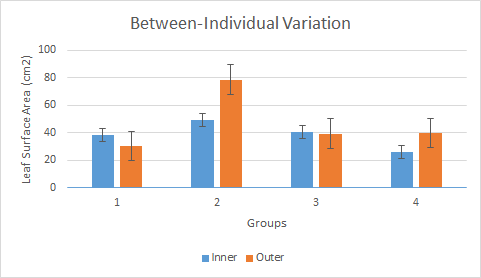
The results of group 1 were much different when compared to the others as well, having a mean average for the outer leaves being lower than the inner leaves. This was either due to an error of the individual in counting or is just part of the overall wide variation of outer leaf size among all the groups. It’s hard to say without a larger sample population.
A student t-test (Fig.3) was also conducted on the data for all groups. The average size of the outer leaves was 47 square-centimeters, and 38.575 square-centimeters for the inner leaves. Due to our p-values being less than our alpha value of 0.05, we have to reject our hypothesis that outer leaves are always inherently smaller than the inner leaves of oak trees. This makes sense, as the outer leaf sizes varied widely among all four of the groups, making it unclear as to whether or not there is a statistical significance.

Overall, it was found that the leaves of the inner layer had a higher surface area than those of the outer layer. This is understandable because on the inner layer the leave have limited sunlight, so they will have a larger surface area in order to gather what little sunlight it is getting. Ecologists and farmers alike would need to understand this because if they were planning on planting a certain crop or studying a specific crop plant, then this pattern of surface area distribution could be consistent with other plants. This would be the significance of the concepts of variation within a species. This is important because it shows how individual parts of a whole organism can be different withing a species depending on what environmental niche those individuals hold.
External Article Analysis
In order to provide a more real world scenario that shows the importance of variation, this article shows how variation within a species can even impact global change. This change being climate change and the variation within a species being that of wildflowers. The questions below will help analyze this article and provide clarification on how this can happen.
- According to Puzey, why does genetic variation persist in the wildflower population under study? Genetic variation persisted because the variation within a certain year selects the alternate genetic makeup and the alternate phenotypes every other year. Meaning that there would be a different set of genes constantly present to be ready for any environmental conditions that would impact the wildflowers.
- How did the study authors address this question? They addressed this question by taking wildflower seeds of the side of a certain mountain and planting them on the side of a mountain that they studied. They then recorded which type of flowers persisted in certain types of weather, i.e. high rain, low rain, high temperature, and low temperature.
- How might you explain the study’s key finding to a general audience? I would say that the reason that there is not one single flower type in an environment that is stable is because the flowers are prepared for anything the environment would throw at it.
- What are the implications of the study’s findings to environmental issues such as climate change and ecosystem disturbance? It implies that although species are going to have a difficult type adjusting to the new drastic weather changes, they are genetically and physically prepared to alter there genes in order to survive.
Peer Reviewed Article: Scheffers, B., De Meester, L., Bridge, T., Hoffmann, A., Pandolfi, J., Corlett, R., … Watson, J. (2016). The broad footprint of climate change from genes to biomes to people. Science, 354(6313), n/a. https://doi.org/10.1126/science.aaf7671
Credit
Bo Nash: Introduction, Oak Leaf picture, Experiment, External Article Analysis
Derik Verkest: Questions 1-4 from Canvas, Experiment and Results, all graphs, conclusion
 ecologylab123
